- Developer
- Mobilia Apps
- Installs
- 50+
- Downloads
- 0
- Views
- 1
- Updated
- Oct 26, 2026
Screenshots
About Feed Ration Calculator
You know what a bag of maize costs this week. You know roughly what your birds need. What you do not have is twenty minutes and a pen to work out how much of each to put in the mixer.
Feed Ration Calculator does that arithmetic, offline, with your prices.
WHAT IT DOES
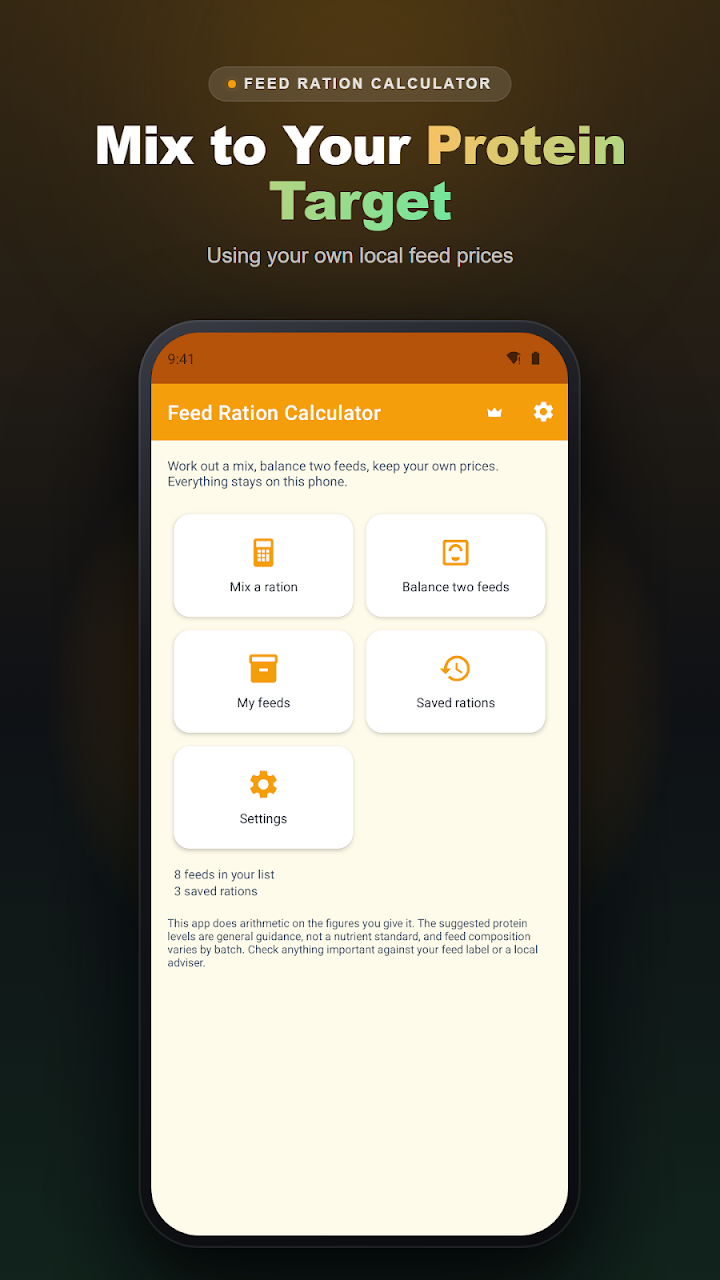
- Mix a ration — pick the animal and stage, tick the feeds you can actually buy, and get a mix that reaches your protein target for as little as the method can manage
- Balance two feeds — the Pearson square, worked out exactly, with the check shown back so you can verify it by hand
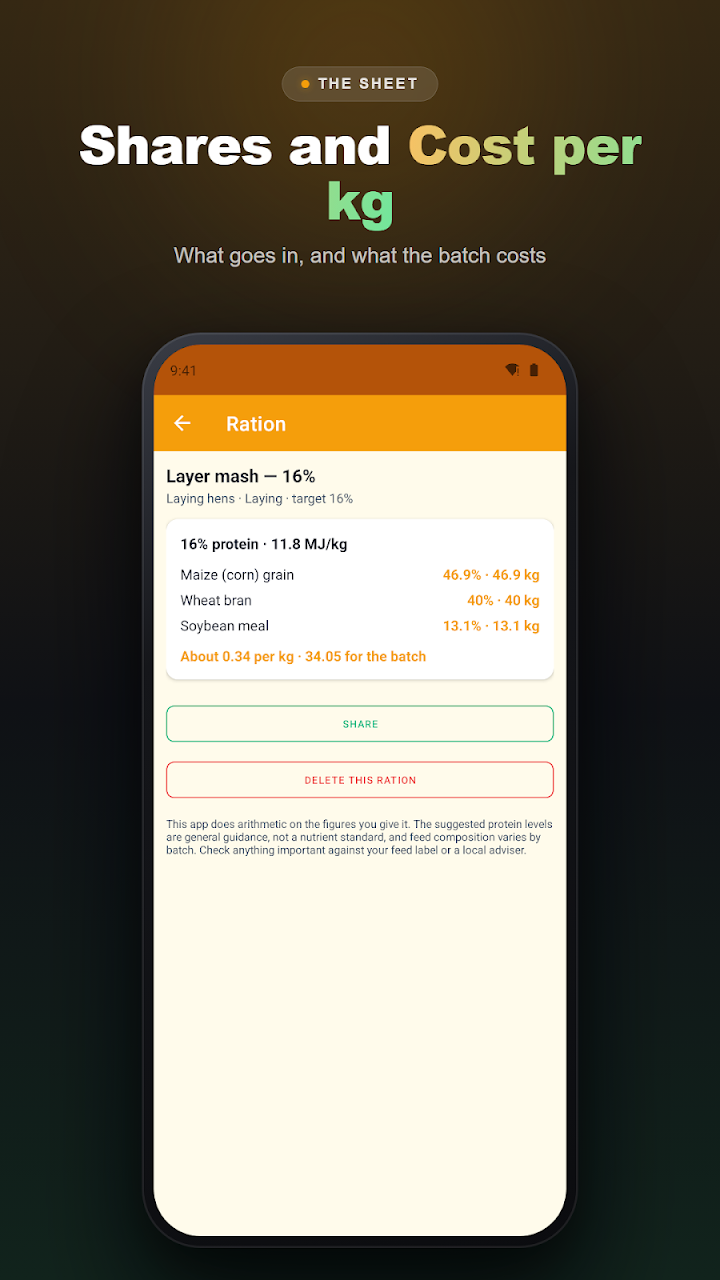
- Batch weights — enter the batch size and get kilograms per feed, not just percentages
- Daily intake and batch sizing — enter how many animals, their body weight and the feeding days, and get kilograms per head per day, for the whole group per day and for the batch, split by feed, with the cost when every feed is priced. Intake starts from a general percentage of body weight that you can edit, or type your own kilograms per head
- Dry matter — give each feed its dry-matter percentage, type label figures on a dry-matter basis, and see the dry matter of the mix and its protein in the dry matter
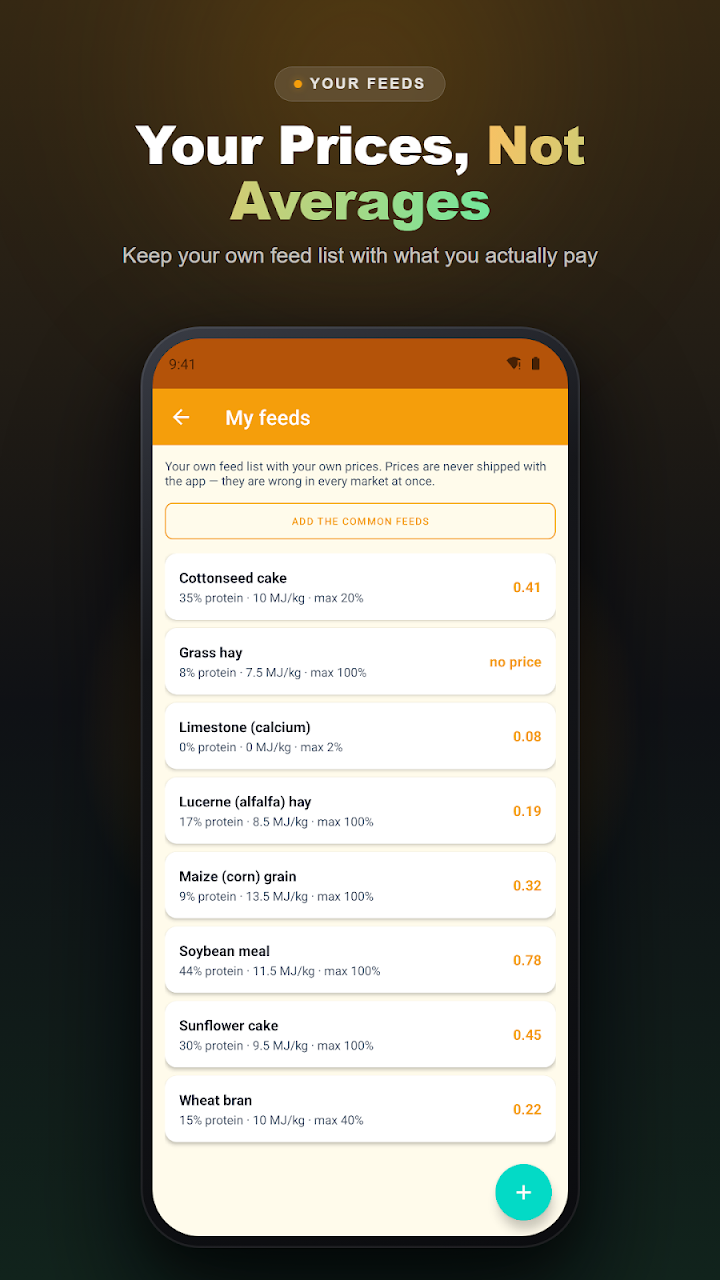
- Your own prices — 21 common feeds are built in with typical composition, but every price is yours
- Safe limits — each feed carries a ceiling for how much of a mix it should be, and the calculator never breaks one. If your feeds cannot make a whole mix within their limits, it tells you so instead of showing one
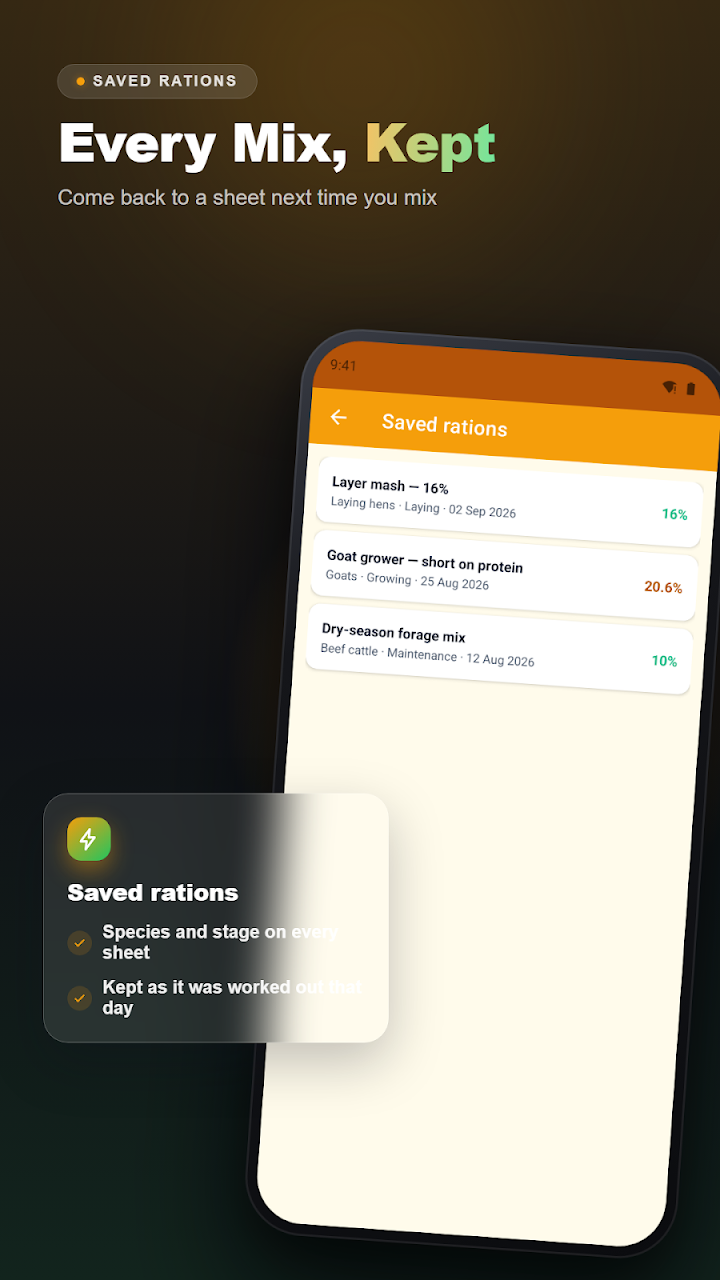
- Save a ration and come back to the mix sheet later
ANIMALS COVERED Dairy and beef cattle, goats, sheep, laying hens, broilers, rabbits and pigs, each with the growth stages that make sense for them.
WORKS WHERE YOU ARE
- Works offline — no account, no sign-up
- No location, no notifications, no permissions beyond the basics
- Your feeds, prices and saved rations stay on the phone
BE CLEAR ABOUT WHAT THIS IS This app does arithmetic on the figures you give it.
The suggested protein levels are widely published general guidance, not a nutrient standard, and they are not specific to your breed, climate or feeding system — they are a starting point you are expected to edit. Feed composition varies by batch, variety, season and storage, so the built-in figures are typical values, not facts about the sack in your shed. The cheap mix is worked out by a simple, stated method: take the cheapest mix, then buy the protein you still need as cheaply as the safe limits allow. It is a practical mix, not a guaranteed least-cost formulation.
Safe inclusion limits exist for a reason. Some feeds are harmful above a few percent — urea in particular is toxic to ruminants above a small amount and of no use to other animals, so the calculator only uses it for cattle, sheep and goats, within its limit. You can mark any other feed the same way. Do not raise a limit you cannot justify.
Daily intake is a rough general figure, not a requirement. Animals eat more in the cold and less in the heat, so treat the batch size as a starting point and adjust it to what your animals actually eat.
Check anything important against your feed label, and talk to a local adviser or vet before making a big change to what you feed.